

Annual Report – Steele/Burnand Anza-Borrego Research Center – September 2026 with Bibliography
The Desert Researcher Magazine is collaboration between Anza-Borrego Foundation, Anza-Borrego Desert State Park and Steele/Burnand Anza-Borrego Desert Research Center, University of California, Irvine. The Desert Researcher Magazine explores the important research happening in Anza-Borrego Desert State Park.
iNaturalist Observations at the Reserve
Current Projects
Fallowed Farmland Rehabilitation
Studying the recovery of former agricultural lands in the Borrego Valley through biological restoration and long-term monitoring. The project evaluates how past agricultural disturbance affects ecosystem recovery in arid environments and investigates restoration strategies that improve habitat quality and reduce dust impacts. Led by Megan Lulow and collaborators at UCI.

Fiore et al. (2025) — “Task 3: Dust Control Treatment Study Report, Biological Restoration of Fallowed Lands in Borrego Valley, California.”
Brigham et al. (2026) — “Disturbance Legacies in Arid Environments Shape Recovery of Former Agricultural Land” published in Restoration Ecology. This appears to be the primary peer-reviewed paper examining how previously farmed desert land recovers following restoration.
Groundwater Dependent Ecosystems (GDE)
Studying hydrological dynamics, wetland persistence, and vegetation responses across the Borrego Valley. The project evaluates how groundwater availability and management practices impact desert aquatic and riparian habitats, supporting long-term conservation and restoration planning for regional water resources.

You can find the full documents and reports by visiting the GDE Update page.
Sentenac Cienega
Ongoing ecological restoration project led by Megan Lulow and collaborators. The project focuses on restoring and monitoring a rare desert wetland ecosystem and tracking ecological change through time. By improving habitat conditions and documenting ecosystem responses, researchers are helping support the long-term conservation of one of the region’s unique natural resources.

Brigham, L.M., Coffey, J., Lulow, M.E., Ta, P., & Kimball, S. (2024). Persistent invasion by non-native species and transition to an upland community after removal of invasive Tamarix in a Californian cienega. Journal of Arid Environments, 220, 105123. View Article
Dust Monitoring
Dust generated from exposed lakebed and desert environments can affect air quality across the Colorado Desert region. Researchers led by Amato Evan of UC San Diego are monitoring dust associated with the Salton Sea to improve understanding of how dust is transported through the atmosphere and how those dust events may affect nearby ecosystems and communities. Supported through the Steele/Burnand Anza-Borrego Desert Research Center, the project contributes to broader research investigating environmental change and human health in Southern California deserts

Desert Atmospheric Chemistry
Air quality and atmospheric processes influence both human and natural systems across desert environments. Researchers led by James Smith are investigating connections among temperature, vegetation, water availability, and atmospheric chemistry to better understand how environmental conditions shape air quality in arid regions. Supported through the Steele/Burnand Anza-Borrego Desert Research Center, the project contributes to a growing understanding of desert climate processes and aerosol formation. Recent findings published by K. Cramer, A. Guenther, and James Smith examined the formation and growth of ultrafine aerosol particles in a Southern California desert, advancing knowledge of how desert atmospheres respond to changing environmental conditions.
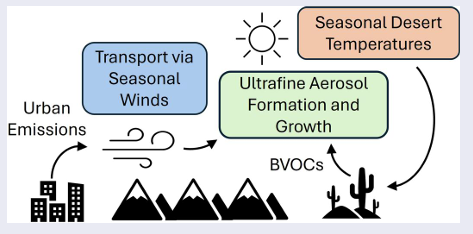
Cramer, K.L., Guenther, A.B., & Smith, J.N. (2026). Ultrafine Aerosol Formation and Growth in a Southern California Desert. Aerosol Science and Technology, 60(6), 665-677.
Biocrust Fungal Associations in California Drylands
This study examined biological soil crusts (biocrusts) across Southern California, including the Anza-Borrego Research Center, and found previously undocumented associations between desert mosses and arbuscular mycorrhizal fungi. The researchers showed that moss-associated fungal communities are distinct from those in adjacent bare soils and documented fungal structures inside healthy moss tissues, suggesting potential symbiotic relationships. The findings improve our understanding of dryland ecosystem function, ancient plant-fungal evolution, and the ecological importance of biocrusts under increasing climate stress.\
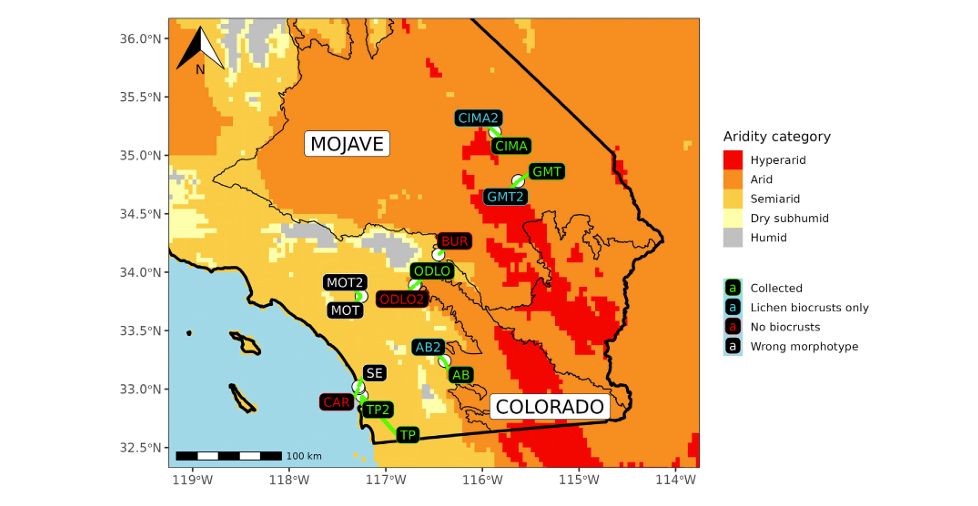
Kelly, K.H., Coleine, C., Coshland, C., & Stajich, J.E. (2026). Novel Glomeromycotina–moss associations identified in California dryland biocrusts. New Phytologist, 251, 151–163. Figure 1.
Remote Sensing of Desert Drought and Wildflower Dynamics
This project investigates whether ephemeral desert wildflower blooms successfully escape intense evaporative stress by dispersing their seeds through time, or if unprecedented 1,200-year drought conditions in the Southwest disproportionately impact ephemeral versus perennial vegetation. By leveraging remote sensing across Anza-Borrego’s diverse flora, the research evaluates how these short-lived blooms respond to hydroclimatic extremes compared to neighboring perennial species.
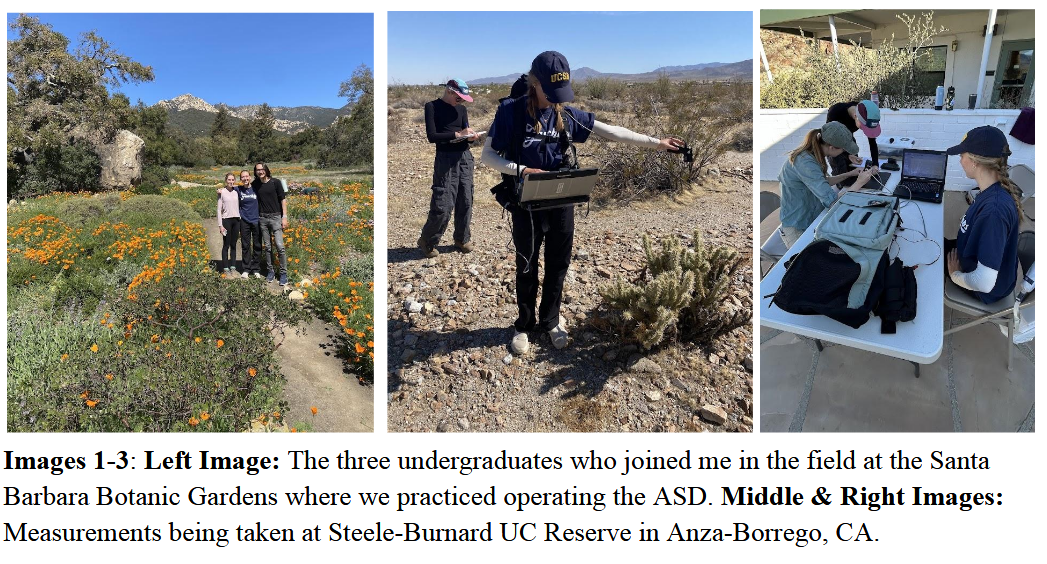
Payne, S. (2025, June 2). Does Ephemeral Vegetation Escape Drought? Remote Sensing Wildflower Blooms in Anza-Borrego, CA. Mathias Graduate Student Research Progress Report, Steele/Burnand Anza-Borrego Desert Research Center, University of California Natural Reserve System.
San Diego County, city of Borrego Springs; two-hour drive from UC San Diego. See Map and Directions
Main hall, 2 classrooms, researcher and student accommodations, laboratory, and kitchen.
13 – 18 cm (5 – 7 inches) per year
35.6 hectares (88 acres), in addition to the 263,046 hectares (650,000 acres) of Anza-Borrego Desert State Park
Steele Burnand Anza-Borrego Desert Research Center: 182 m (597 feet) Anza Borrego Desert State Park: 18 – 1,888 m (60 – 6,193 feet)
November – March: 24ºC (75ºF)
April and October: 29ºC (85ºF)
May – September: 41ºC (105ºF)
Summer Maximum: 50ºC (121ºF)